Documentation Index
Fetch the complete documentation index at: https://docs.sprig.com/llms.txt
Use this file to discover all available pages before exploring further.
The Open-Text Analysis Problem
One of the richest sources of customer experience data is an open-text survey response. Historically this is also one of the most difficult data formats from which to extract meaningful insights, especially at scale. When product teams run surveys with open-text questions, a common goal is to group the huge number of responses into a small number of bite-size and actionable takeaways. The identified themes are shared with product stakeholders and play a critical role in determining how to improve the product experience. An example with some responses and a summarizing theme could be:- Response: “I’m lost, can’t really find anything easily in the product.”
- Response: “It’d be nice if there was a way to find users by name.”
- Response: “Please add a search field.”
Solution create a theme: “Add search functionality”
Performed manually, this analysis takes the form of:- placing the responses into a large spreadsheet
- reading through them to locate patterns
- defining themes that represent actionable groups of responses
- assigning all responses to one or more of these themes (a.k.a. “coding”).
Sprig Open-Text AI Analysis
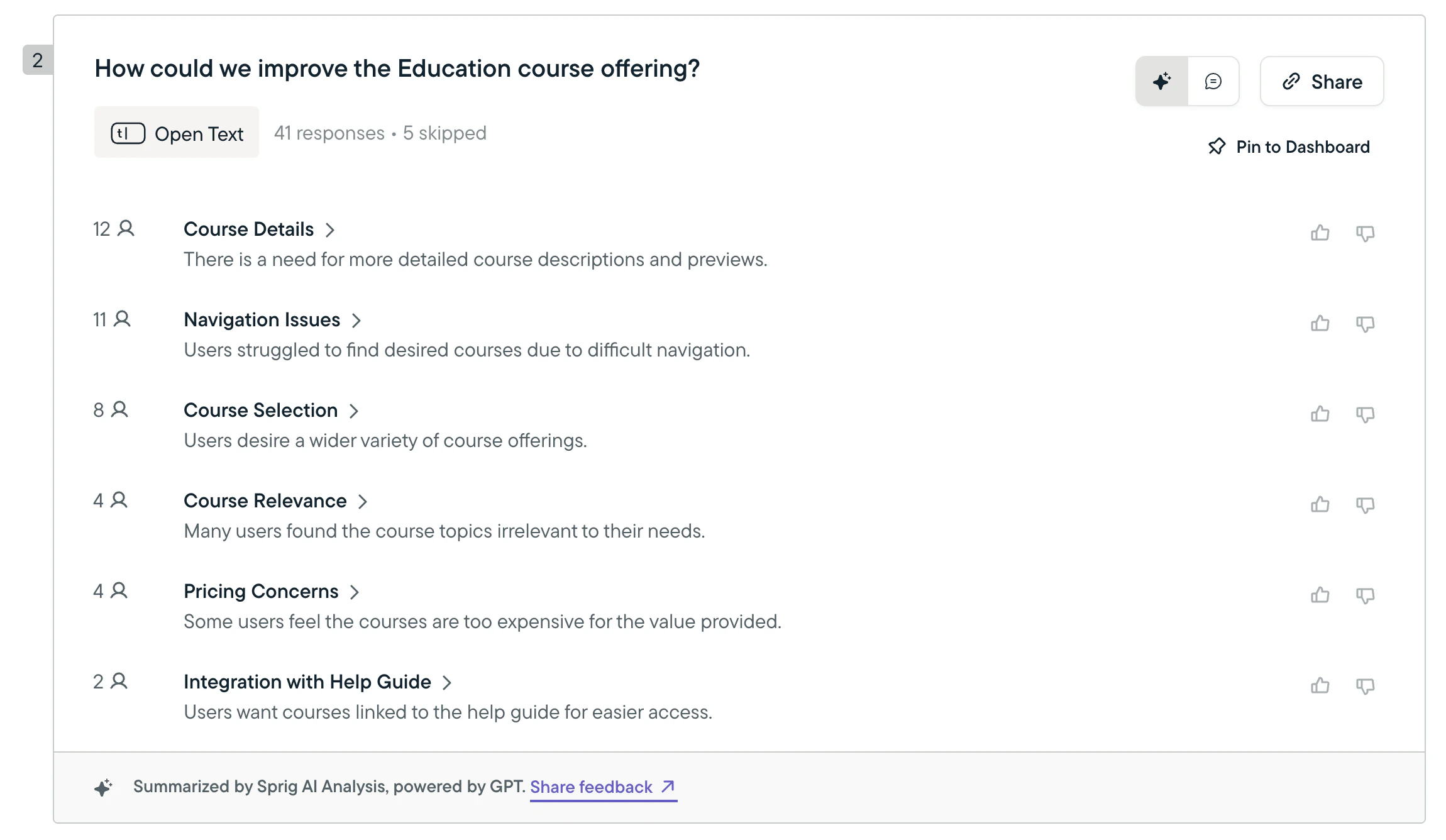
Sprig Open-Text AI Analysis saves you from endless manual analysis by automatically transforming open-text survey responses into actionable product insights with the power of OpenAI’s GPT large language model. AI Analysis synthesizes open-text survey feedback into product opportunities and issues with additional summary details, so you have a clear-cut picture of your users’ feedback without having to review individual responses.How it works
- Sprig sends responses to OpenAI’s GPT model to generate summary themes, which include a short label with description capturing the nuance of the responses.
Note that OpenAI API data is automatically deleted after 30 days and NOT used to train the Open AI models.
- Each response is processed and categorized, making Sprig’s Open-Text Analysis far more relevant and accurate than typical LLM summaries of Open-Text data
- As new responses come in, themes are assigned in real time, and themes regenerate to account for shifts in response clusters.
- Themes are also monitored by humans for quality assurance, and Sprig makes periodic updates to the AI, however, Sprig does not use customer or user data for any data training at any time.
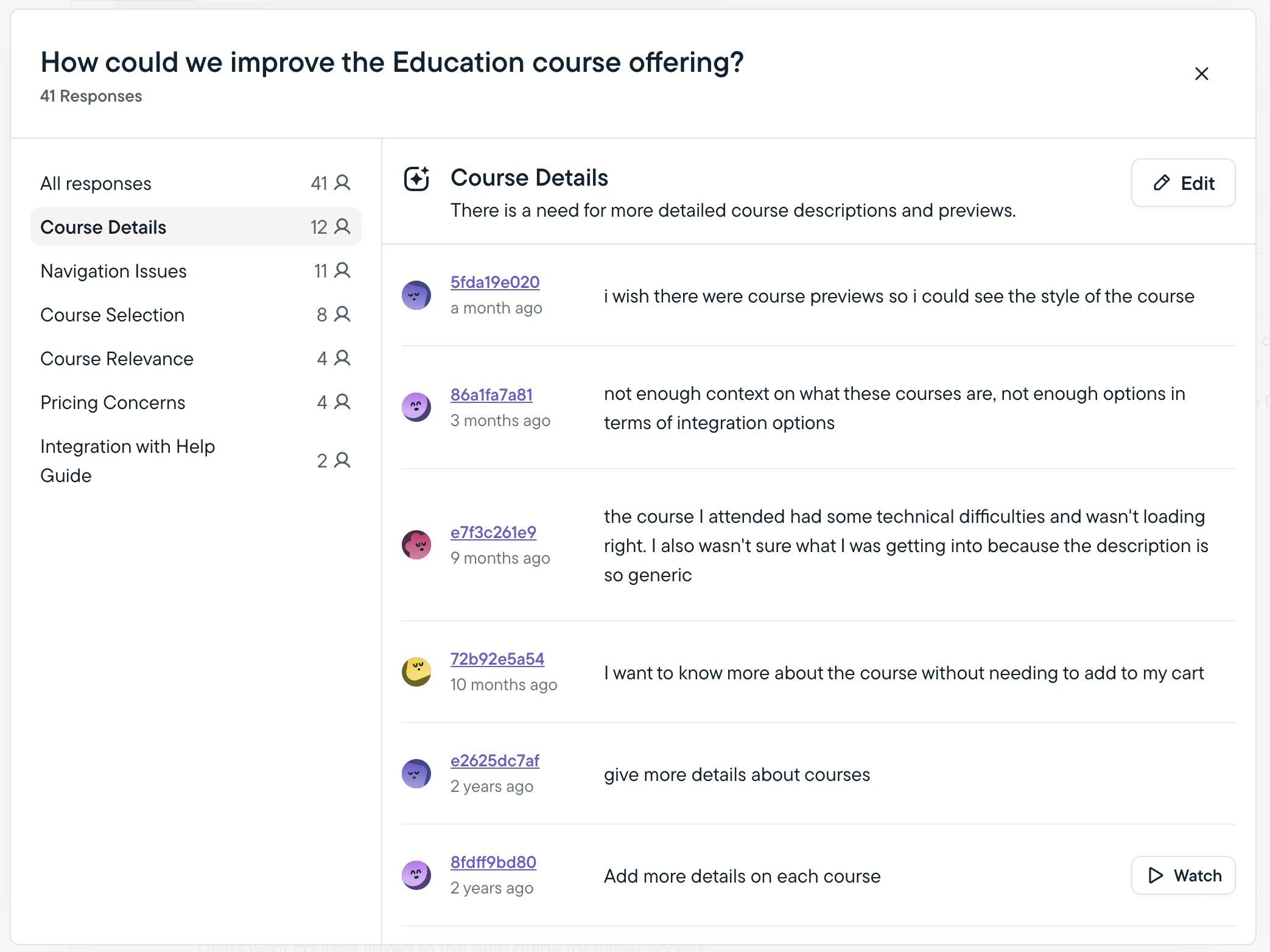
- Sprig will always cite the source of each theme, and users can click into each theme to review contributing survey responses.
- Users can update the Agent Context to re-run the study AI analysis at any time.
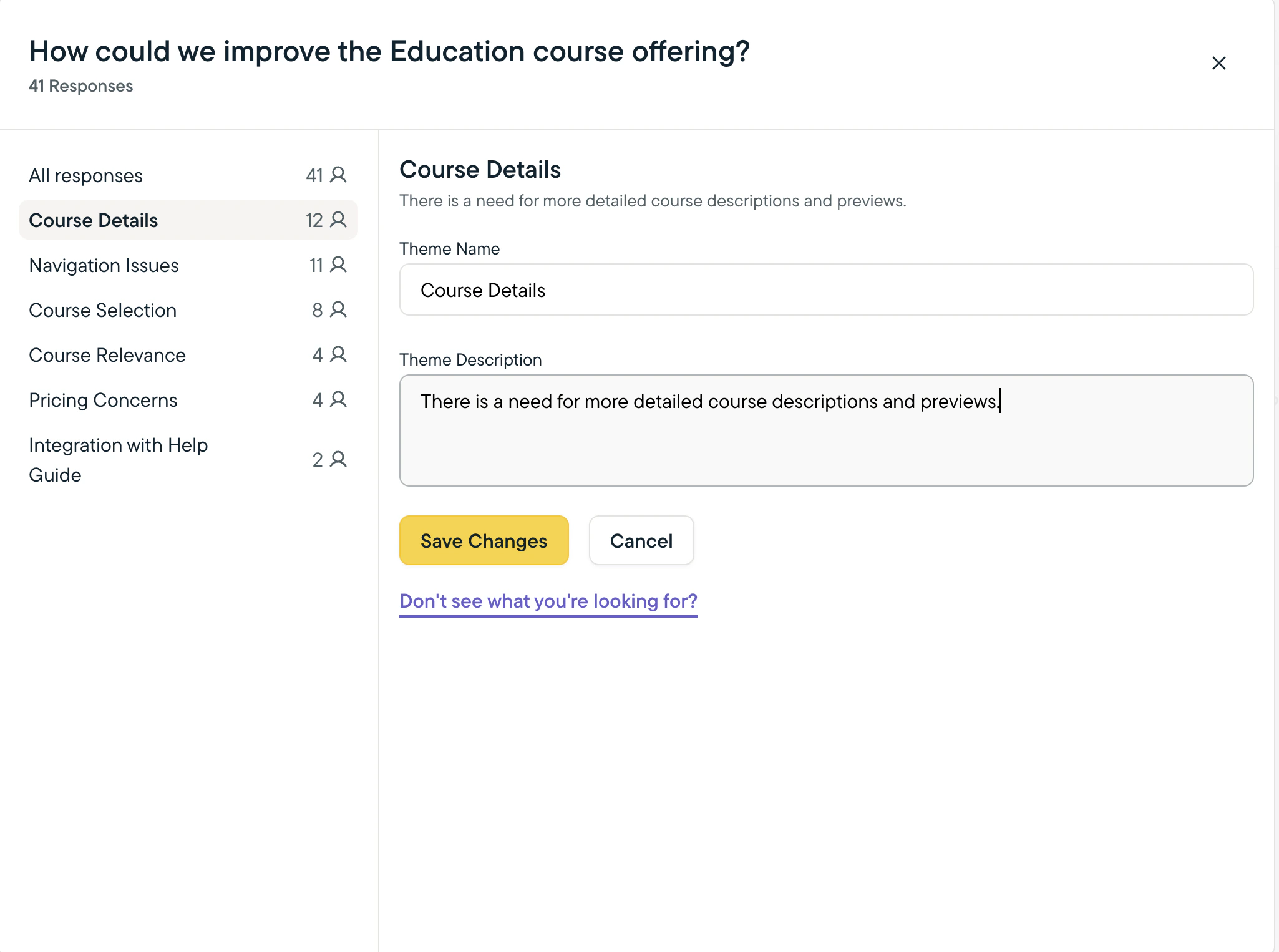
- Users can also elect to edit the theme names and descriptions by selecting “Edit” when reviewing responses, to match company language more closely.
- Users can also elect to export the Open-Text AI Analysis in tandem with survey responses for deeper analysis, reporting, or charting outside of Sprig.
To find the AI themes generated by the responses to your open-text questions:
- In the Navigation pane, click Studies. Click on the study in question.
- Click Summary, then scroll down to the open-text question response table.
- All themes identified by Sprig will be shown in the table. Make sure to click
 on any themes of interest to review the individual open-text responses driving it.